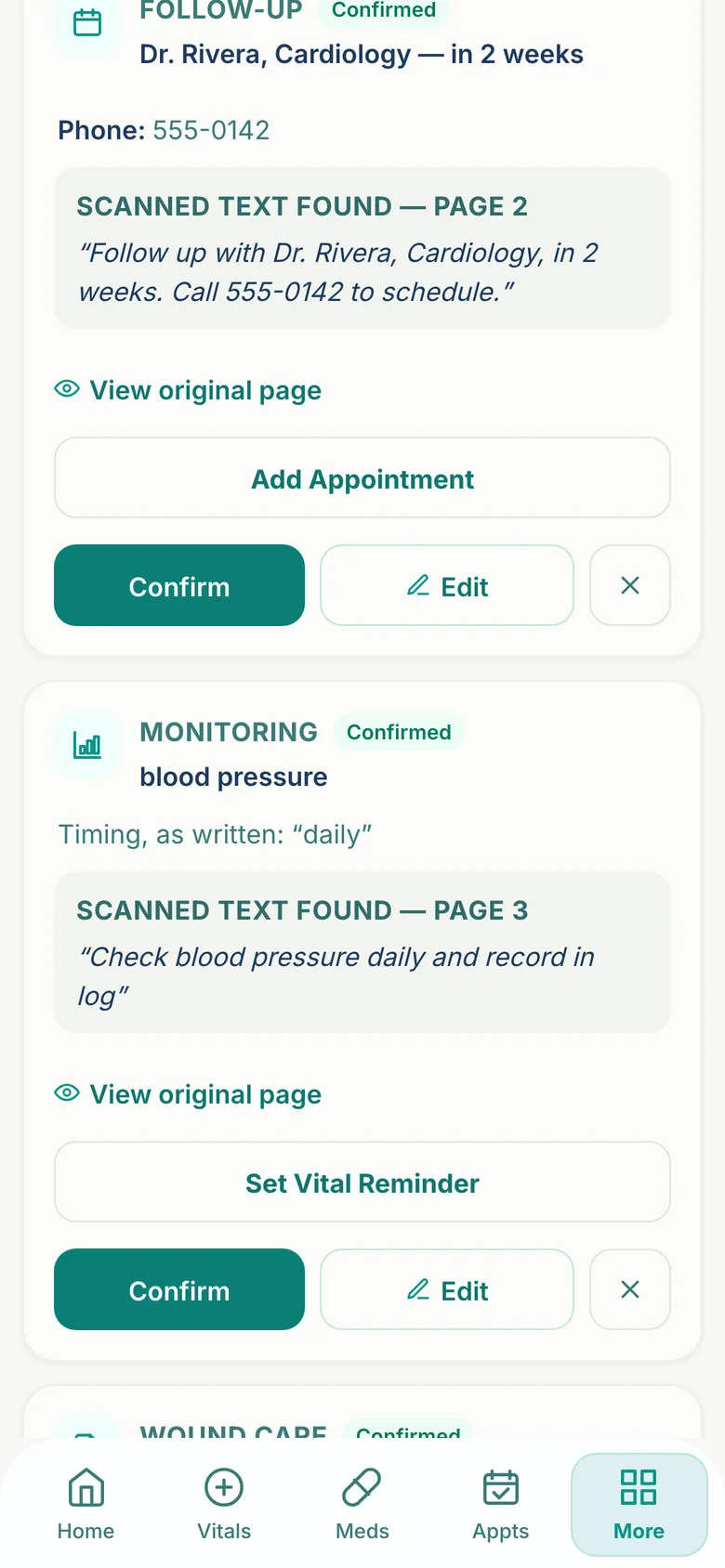
Review the instructions
Upload the discharge pages and check each proposed item against the original before confirming it.
 Open VitaLink ↗
Patients & families
For yourself, a dependent, or someone who trusts you to help. Keep people connected while keeping their information distinct.
An example of everyday care
An older adult returns home with several medications and discharge instructions. A family member wants to help keep the details organized.
Upload the discharge pages and check each proposed item against the original before confirming it.
Review medication details and schedules, then arrange eligible follow-ups and recovery tasks.
Choose available information to share with a caregiver, and bring recorded readings or reports to the next care conversation.
Illustrative situation, not a patient testimonial. Medication decisions stay with the care team; this example does not claim reduced readmissions.
Patient-controlled sharing
A patient can invite a caregiver and choose which available categories of health information to share.
Invite a caregiver through the application’s existing connection process.
Select available categories, such as vitals, medication information or history.
A caregiver connection and a dependent profile serve different purposes; records remain person-specific.
Some shared appointment and adherence views depend on deployment availability. This website does not grant access to anyone’s information.
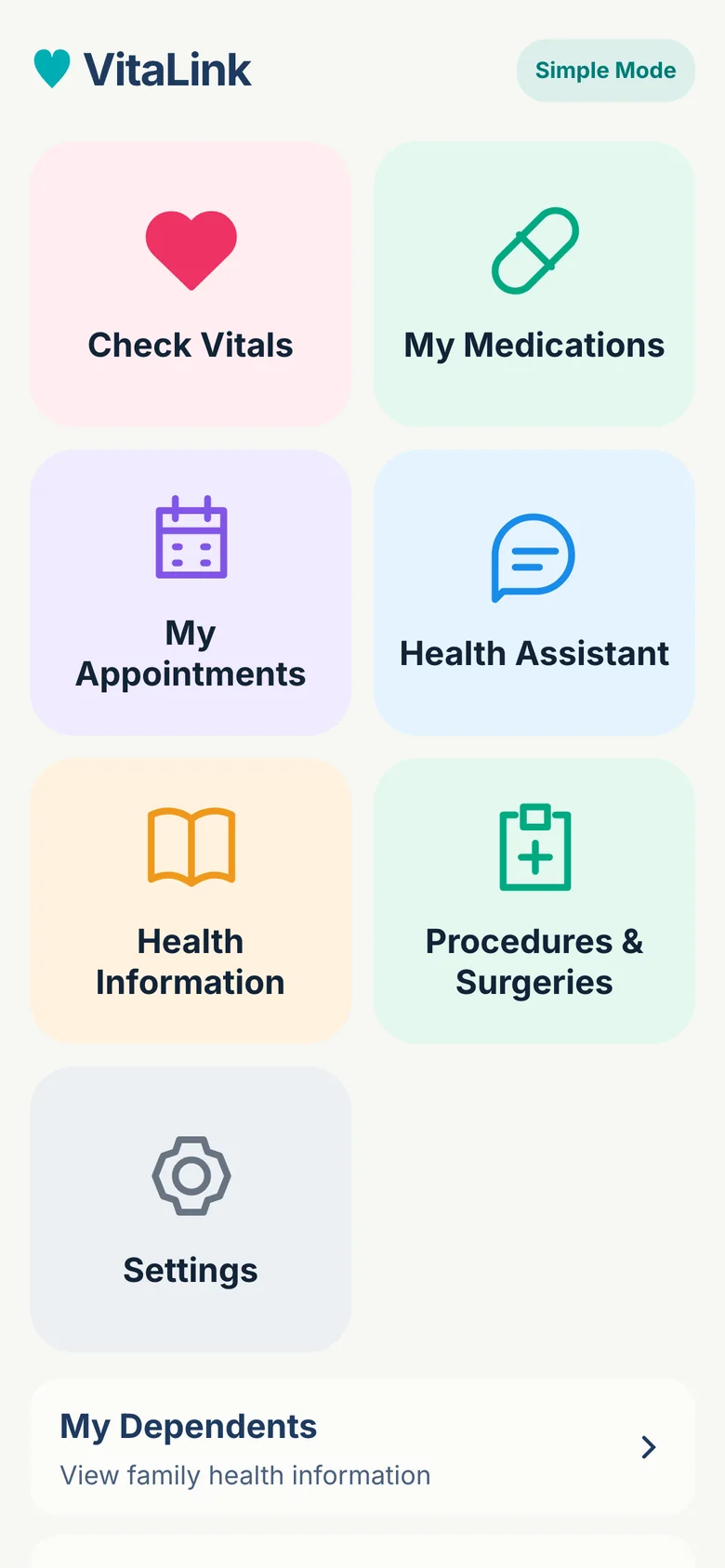
Simple Mode
Simple Mode gives essential tasks more space, with large buttons and plain labels. It is designed for older adults and anyone who prefers less on-screen complexity.
Simple Mode changes how you navigate the app; it does not create a separate account or replace the broader platform.
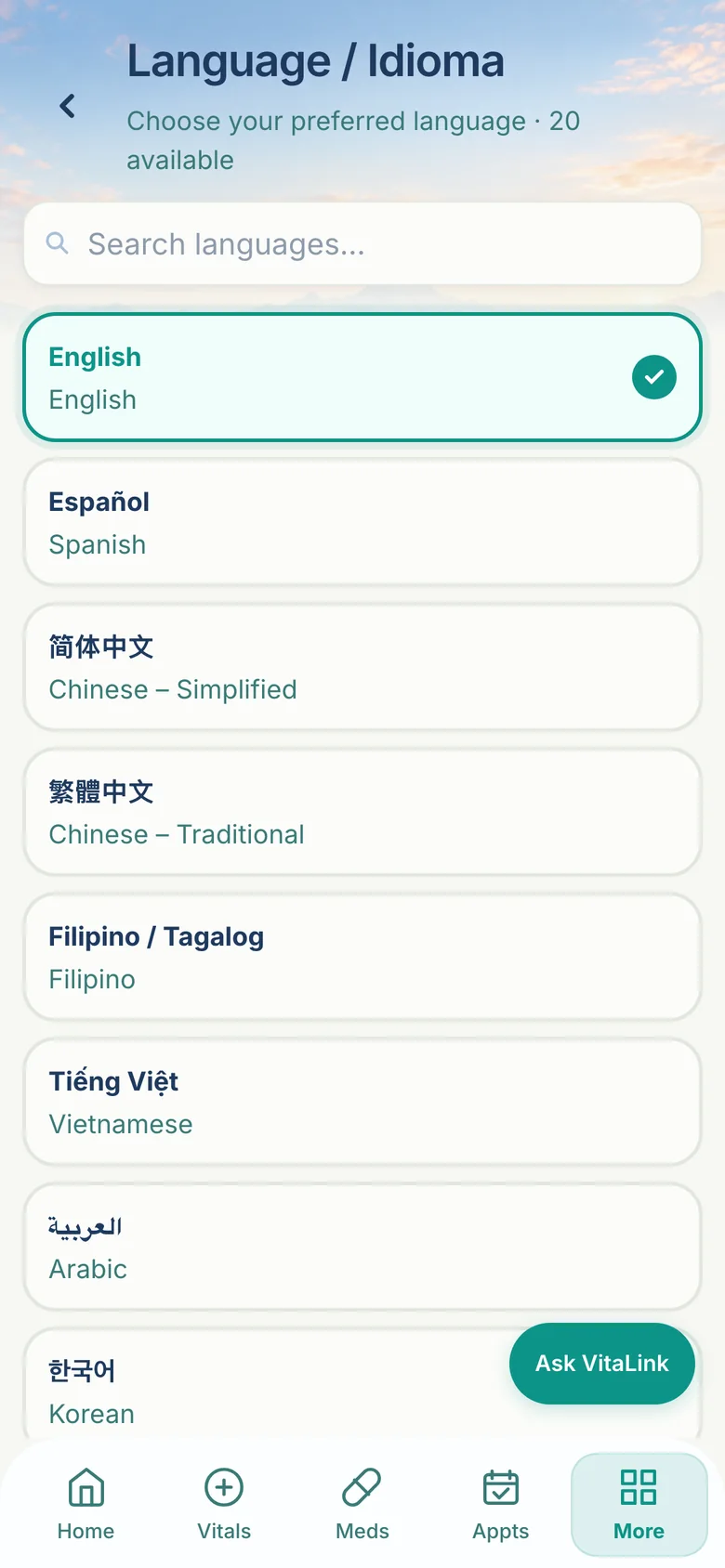
20 interface languages
The app supports 20 interface languages, including right-to-left layouts. Language and display preferences sit alongside the same broader platform.
English, Spanish, Simplified Chinese, Traditional Chinese, Filipino/Tagalog, Vietnamese, Arabic, Korean, Russian, Armenian, Persian, French, Haitian Creole, Portuguese, Hindi, Urdu, Bengali, Punjabi, Gujarati and Japanese.
Formal accessibility and intended-population usability validation remain development work. Language support is not clinical translation certification.